Concepts and formulae of Pyramid and Tetrahedron for SSC CGL
📑 Contents
A Pyramid is a three-dimensional polyhedron of which one face is a polygon of any number of sides, and the other faces are triangles with a common vertex.
A pyramid with an n-sided base will have n + 1 vertices ,n + 1 faces , and2n edges.
**Right Pyramid: A right pyramid has its apex directly above the centroid of its base.
Regular Pyramid: A regular pyramid has a regular polygon base.
Generic Formulas:
Volume Of Pyramid = 1/3**× Base Area × Height**
Surface Area Of pyramid =1/2 × Perimeter of base × Slant Length
(only when all side faces are the same)
Surface Area = Base Area + Lateral Area
(When side faces are different)
Regular Right Pyramid with Square base ( pentahedron**):**
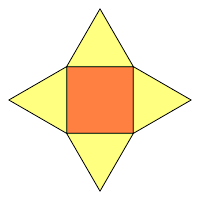
** A Square pyramid is a pyramid having a Square base and the other faces are all triangles.
There are (4+1) faces, 5 vertices and 8 edges in a pentahedron.
Formulas:
 ****
****
**** V = 1/3 Bh
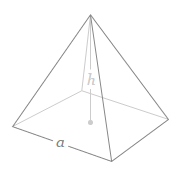
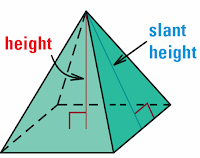
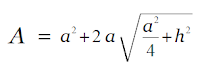
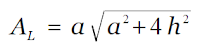
where, e is the edge length, s is the slant height, h is the height, A is the Surface area, A L is the lateral Surface area, B is the area of the square base and a is the length of a side of the base.
Regular Right Pyramid with Triangular base (Tetrahedron):
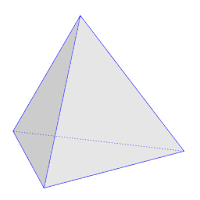
** A triangular pyramid is a pyramid having a triangular base.
The tetrahedron is a triangular pyramid having congruent equilateral triangles for each of its faces.
There are 4 faces , 4 vertices and 6 edges in a tetrahedron.
**h =(√2)/(√3) ***** (Side)
**A L =(3√3)/4 * (Side)2
****A =(4√3) /4 * (Side)2
**V = (√2)****/ 12 * (Side)3 ** (Since V= 1/3 Bh )
_where, e is the edge length, s is the slant height, h is the height,__A L is the lateral Surface area,__A is the Surface area, V is Volume, B is the area of the base and a is the length of a side of the base.
|| Prism, || Cone, || Cylinder, || Sphere,Hemispheres, ||
|| Parallelepiped, || Pyramid ||
📚 Related posts
Testing
just testing site
 Welcome to the new QMaths Blog
 Welcome to the new QMaths Blog
We've rebuilt the QMaths blog from scratch — faster, mobile-first, and fully focused on free SSC, Railway and Banking exam content. Here's what's coming.
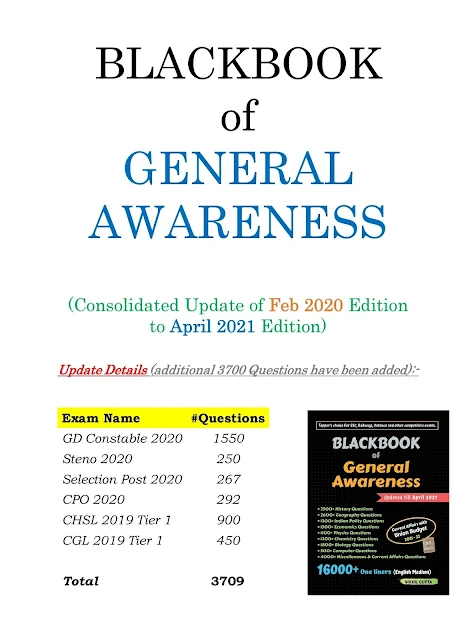 Blackbook of General Awareness Update PDF 2021 Download
 Blackbook of General Awareness Update PDF 2021 Download
Blackbook of General Awareness Update PDF 2021 Download. Blackbook of General Awareness Update PDF 2021 DownloadBlackbook of General Awareness (BBGA 2.0) consists o
![SSC CHSL 2019 T1 Update [Blackbook of General Awareness]](https://assets.blog.qmaths.in/blog-img/bc/bcde20badf5b8abcabc8692600487732c88bf4d8.jpg) SSC CHSL 2019 T1 Update [Blackbook of General Awareness]
SSC CHSL 2019 T1 Update [Blackbook of General Awareness] SSC CHSL 2019 T1 Update [Blackbook of General Awareness]
SSC CHSL 2019 T1 Update [Blackbook of General Awareness]. SSC CHSL 2019 T1 Update [Blackbook of General Awareness]Click Here to Download SSC CHSL 2019 Tier 1